Good to Know
Group attractive native plants and reduce yardwork
Maintaining a yard can be a burden—especially during summer's spiking temperatures. Instead, consider giving yourself a break by replacing parts of your landscape with beautiful, low-maintenance native plants.
Native plants incorporated into a landscape are adapted to local soil and climate conditions, and therefore require less maintenance or fertilizer.
Creating areas of low-maintenance native plantings not only means less time mowing, but helps reduce erosion and runoff.
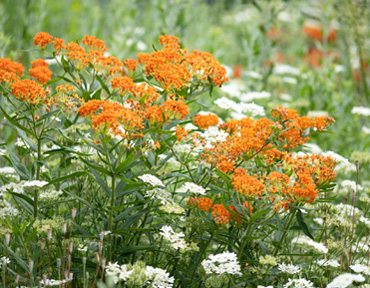
Butterfly Weed with Common Yarrow
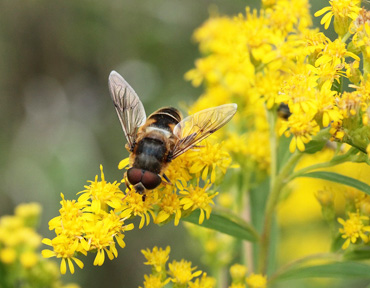
Bee on Goldenrod
“Natives have significantly deeper roots than non-natives or lawn grass, which allow filtration,” said Blair Blanchette, Virginia Conservation Assistance Program coordinator for the Virginia Association of Soil and Water Conservation Districts. “They may require extra maintenance to stay alive in their first summer, but once they’re established, they do their own thing. It shouldn’t be as much work as your lawn!”
Lawn care can be expensive too, noted Blanchette. “And we are losing wildlife habitat. The benefits are multi-level when you replace a lawn or impermeable surface with a native garden.”
Horticulturalist Mark Viette said groupings of native plant combinations can be an attractive enhancement that reduces mowing space, entices pollinators and creates habitat for wildlife.
Watch this video: Horticulturalist Mark Viette suggests planting native plants to attract pollinators to the landscape in this clip from Real Virginia.
“The orange flower butterfly weed called Asclepias tuberosa is a fantastic plant that attracts species,” he said. “It’s a food source for the caterpillars, and it’s beautiful.”
Goldenrod thrives in open areas and enriches the soil with nitrogen. Ironweed adds a splash of purple to landscapes prone to water saturation.
Grouping natives with similar sunlight, soil and water requirements is easier to maintain and adds dimension, Viette advised. “Group five butterfly plants together, then five of another, and so on.”
Spinach packs a powerful nutritional punch
The cartoon character Popeye the Sailor Man was onto something when he touted the health benefits of spinach.
That’s because spinach is packed with nutrients and antioxidants. It’s a rich source of vitamins A, C and K, fiber, folic acid, iron and potassium. And there are only 7 calories and 24 milligrams of sodium per 1-cup serving.
Some studies show eating spinach may reduce oxidative stress, which can accelerate aging and increase your risk for diabetes and cancer. Spinach also may promote eye health and regulate your blood pressure.
This versatile leafy green is high in insoluble fiber and can be enjoyed both raw and cooked. Throw spinach in a salad, or mix it with other ingredients for a delicious heated side dish or appetizer.
While spinach is not a major crop in the commonwealth, it is widely grown around the state and can be found growing in more than 50 Virginia counties, with Augusta, Culpeper and Floyd leading the way.
Spinach and Quinoa Pilaf
Combine spinach and quinoa for a healthy side dish. Throw in some garlic, onion and a pinch of lemon zest, and you've got yourself a winning recipe!
See Recipe
Historic farmers markets remain popular in modern times
Farmers markets have a rich history in the United States—and Virginia.
The first U.S. market was established in 1730 in the center of Lancaster, Pennsylvania, according to the U.S. Department of Agriculture.
Farmers markets have increased in number and popularity over the years. In 2019 there were more than 8,000 markets in operation nationwide, according to USDA.
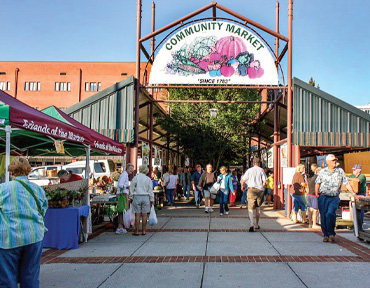
Lynchburg Community Market
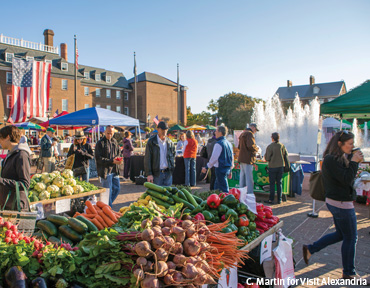
Old Town Farmers’ Market
Virginia has almost 300 farmers markets of its own. Three of the oldest ones have thrived for more than 100 years.
Old Town Farmers’ Market
The Old Town Farmers' Market is one of the longest continuously operating farmers markets in the U.S. A centuries-old tradition is still celebrated every Saturday at Market Square in Alexandria, where commerce and agriculture have intersected since 1753.
The market offers something for everybody and attracts thousands of families, foodies, tourists and neighborhood regulars. Within view of Alexandria City Hall, more than 70 vendors sell farm-grown produce throughout the seasons, plus meats, seafood, dairy products, breads, pastries, hot prepared foods, juices, ciders, cut flowers and potted plants.
Lynchburg Community Market
The third-oldest continuously operating farmers market in America, the Lynchburg Community Market has a rich history in Virginia’s southern Piedmont.
The market was established in 1783 as a town square for the expanding city, serving as a social gathering space. The open-air market took on a commercial component when rebuilt in 1814.
Historic Roanoke City Market
In the heart of downtown Roanoke, the Historic Roanoke City Market has flourished with a sense of community and tradition for more than 140 years.
At the same location since its founding in 1882, the market boasts the title of Virginia’s oldest continuously operating open-air market. Open seven days a week, it offers residents fresh, local foods and artisan crafts from around 50 farmers and craftsmen.
“It’s such a jewel,” said Eric Pendleton, the market’s manager. “We have some vendors whose families go back to the 1920s at this market. It’s become such a tradition.”
Plan your visit:
Old Town Farmers’ Market: 301 King St., Market Square, Alexandria. Open 7 a.m. to noon every Saturday, rain or shine
Lynchburg Community Market: 1219 Main Street, Lynchburg. Open 7 a.m. to 2 p.m. every Saturday, year-round
Historic Roanoke City Market: Market Square SE, Roanoke. Open 11 a.m. to 2 p.m. every Saturday